
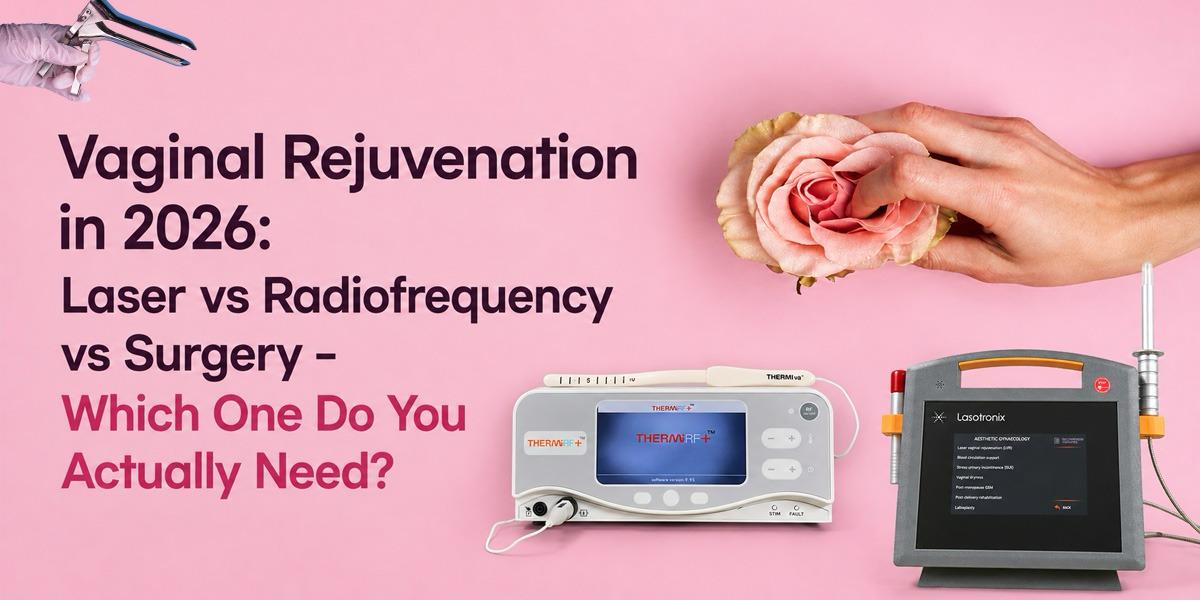
If you are considering vaginal rejuvenation in Ahmedabad, the first question should not be “Which treatment is best?” but “What problem am I actually trying to treat?” Laser, radiofrequency (RF), and surgery are very different approaches, and the right option depends on your symptoms, anatomy, medical history, and treatment goals.
“Vaginal rejuvenation” is a broad term used for several procedures aimed at addressing concerns such as vaginal laxity, dryness, discomfort during intercourse, changes after childbirth, or concerns about the appearance of the vulvovaginal area. However, not every woman with these concerns needs a procedure, and not every procedure is suitable for every problem.
What is vaginal rejuvenation?
Vaginal rejuvenation is a general term rather than one specific medical procedure. Depending on the individual, treatment may involve non-surgical energy-based procedures such as laser or radiofrequency, pelvic-floor rehabilitation, or surgery such as vaginoplasty or perineoplasty.
The important distinction is that these treatments work in very different ways.
Laser and RF treatments are non-surgical procedures that use energy to heat or affect vaginal or vulvovaginal tissues. Surgery, on the other hand, physically modifies or repairs tissues.
Medical organisations have also highlighted that evidence for many cosmetic or “rejuvenation” claims remains limited. The American College of Obstetricians and Gynecologists (ACOG) has specifically noted concerns about energy-based devices marketed for vaginal rejuvenation and recommends careful counseling about potential benefits and risks.
That is why an individual assessment is more important than simply choosing the latest technology.
Do you need laser vaginal rejuvenation?
Laser vaginal rejuvenation generally uses fractional laser energy, commonly CO₂ or Er technology, to deliver controlled energy to vaginal tissue.
The proposed mechanism is to stimulate tissue remodeling and collagen production. Some studies have reported improvements in symptoms such as vaginal dryness, vulvovaginal atrophy, and menopausal discomfort. However, the available evidence has limitations, including small study populations and relatively short follow-up periods.
Laser treatment may therefore be discussed in selected patients, but it should not be presented as a universal solution for vaginal laxity, sexual concerns, urinary symptoms, or cosmetic changes.
It is also important to distinguish symptom treatment from cosmetic treatment. A woman experiencing vaginal dryness due to menopause, for example, needs a different clinical evaluation from someone concerned primarily about laxity after childbirth.
What are the limitations of laser treatment?
Laser procedures are often marketed as quick, painless “rejuvenation,” but patients should understand that results are not guaranteed and long-term evidence remains limited for several commonly advertised indications.
Potential risks of energy-based vaginal procedures can include pain, burns, scarring and changes in sexual comfort. ACOG notes that the FDA has not cleared or approved energy-based devices specifically for vaginal “rejuvenation” or vaginal cosmetic procedures.
So, if you are researching laser vaginal rejuvenation cost India, do not compare clinics based only on the package price. Ask what device is being used, why it has been recommended for your specific concern, what evidence supports the indication, how many sessions are expected, and what alternatives are available.
Could RF vaginal tightening be right for you?
RF vaginal tightening uses radiofrequency energy to heat tissue and is promoted for tissue remodeling and tightening. Unlike surgery, it does not involve cutting or removing vaginal tissue.
Some clinical studies have reported short-term improvements in certain symptoms and sexual-function measures after RF treatment, but evidence varies depending on the condition being treated. AUGS has noted that research into vaginal energy-based devices is still limited for several indications and that long-term outcomes are not well established.
RF may be considered when a patient wants a non-surgical approach and has an appropriate indication. But “non-surgical” does not automatically mean “risk-free” or “better.”
A proper examination should come before treatment.
What is non-surgical vaginal rejuvenation – and when does it make sense?
Non-surgical vaginal rejuvenation usually refers to treatments that do not involve surgical cutting or reconstruction. Depending on the clinic and technology, this may include laser or RF-based procedures.
The biggest advantage is that these treatments generally involve less downtime than surgery. However, they cannot physically repair every type of anatomical change.
For example, if a woman has significant tissue separation, a substantial perineal defect after childbirth, or pelvic organ prolapse, an energy-based procedure may not address the underlying structural problem.
In some women, pelvic-floor physiotherapy, lubricants or moisturisers, hormonal or non-hormonal treatment for menopause-related symptoms, or treatment of an underlying gynaecological condition may be more appropriate than a “rejuvenation” procedure.
The goal should always be treating the actual cause, not simply treating the label of vaginal laxity.
When might surgery be a better option?
Surgery is fundamentally different from laser or RF because it can directly modify or repair anatomical structures.
Procedures such as vaginoplasty or perineoplasty may be considered in carefully selected patients when there is a significant structural concern. Depending on the individual case, surgery may be discussed for substantial vaginal or perineal laxity, tissue changes following childbirth, or other anatomical concerns.
However, surgery is not automatically the “strongest” or “best” version of rejuvenation.
It involves anaesthesia, recovery, wound healing and surgical risks. ACOG also emphasises that women considering genital cosmetic procedures should receive appropriate counseling about the lack of high-quality evidence for some procedures and their potential complications.
The right question is therefore:
“Is there a structural problem that actually requires surgical correction?”
If the answer is no, surgery may be unnecessary.
Laser vs RF vs surgery: Which one do you actually need?
There is no single treatment that is best for every woman.
| Treatment | What it does? | Usually considered when | Key consideration |
| Laser | Uses controlled laser energy to affect vaginal tissue | Selected vaginal tissue or menopausal symptoms, depending on assessment | Evidence and long-term safety vary by indication |
| RF | Uses radiofrequency energy to heat tissue | Selected patients seeking a non-surgical approach | Results and evidence vary; not a substitute for structural repair |
| Surgery | Physically repairs or modifies tissue | Significant anatomical or structural concerns | More invasive, with surgical recovery and risks |
| Pelvic-floor treatment | Improves pelvic-floor muscle function | Weakness, some urinary symptoms, pelvic-floor dysfunction | May be more appropriate than “tightening” procedures |
This comparison is why a consultation should come before choosing a treatment package.
How do you know if vaginal laxity is actually the problem?
The feeling of “looseness” can have several causes.
Pregnancy and childbirth can alter the pelvic floor and perineal tissues. Hormonal changes can affect vaginal tissue quality. Pelvic-floor muscle dysfunction can also contribute to changes in sensation or urinary symptoms.
At the same time, sexual sensation is influenced by many factors, not simply vaginal diameter.
A specialist evaluation can help determine whether the concern is related to pelvic-floor muscles, vaginal tissue, perineal anatomy, hormonal changes, prolapse, pain, or another condition.
This is particularly important if you have symptoms such as:
- A feeling of vaginal heaviness or pressure
- A bulge coming down through the vagina
- Pain during intercourse
- Persistent vaginal dryness
- Repeated tearing or discomfort
- Urinary leakage
- Changes following childbirth
- Persistent vulvar or vaginal pain
These symptoms deserve a medical assessment rather than being automatically labelled as a need for “rejuvenation.”
What should you ask before choosing a vaginal rejuvenation treatment in Ahmedabad?
If you are considering vaginal rejuvenation in Ahmedabad or elsewhere in Gujarat, ask these questions during your consultation:
1. What is causing my symptoms?
Do not start with the device. Start with the diagnosis.
2. Is my concern medical, structural, functional, or cosmetic?
The answer can significantly change the treatment recommendation.
3. Do I actually need a procedure?
Sometimes the most appropriate treatment is not an energy-based procedure or surgery.
4. What results can realistically be expected?
Be cautious about promises of permanent tightening, guaranteed sexual enhancement, or “rejuvenation” of every vaginal concern.
5. What are the risks and alternatives?
A good consultation should include both.
For patients seeking specialist care, Dr. Krupa Bhagat, a vulvovaginal surgeon, evaluates vulvovaginal concerns with an emphasis on identifying the underlying problem before recommending an appropriate treatment approach.
Is vaginal rejuvenation safe in 2026?
Safety depends on the specific procedure, indication, device, technique, patient and provider.
The American Urogynecologic Society (AUGS) has developed consensus guidance on vaginal energy-based devices because evidence remains limited for several conditions. The organisation notes that some laser technologies have demonstrated short-term effectiveness for selected menopausal conditions, but further research is needed.
Therefore, “safe” should not be treated as a blanket description for every laser or RF treatment.
A consultation with a qualified specialist helps determine whether a particular procedure is appropriate for you and whether another treatment may provide a better balance of benefit and risk.
What is the best approach to vaginal rejuvenation?
The best approach is individualised treatment based on your actual anatomy and symptoms.
If your concern is primarily hormonal vaginal dryness, the treatment pathway may be completely different from someone with post-childbirth structural changes.
If you have pelvic-floor weakness, strengthening and rehabilitation may be more useful than an energy-based treatment.
If there is significant anatomical damage or a structural problem, surgery may sometimes be appropriate.
And if your concern is mild and does not represent a medical problem, you may not need a procedure at all.
The aim should never be to make the vagina “tighter” simply because that is what a treatment package promises. The aim is to improve your comfort, function and quality of life safely and appropriately.
Frequently Asked Questions About Vaginal Rejuvenation
1. Is vaginal rejuvenation necessary after childbirth?
Not necessarily. If you experience persistent laxity, pain, urinary leakage, prolapse, or discomfort, consult a specialist to determine if treatment is needed.
2. Is laser or RF better for vaginal tightening?
Neither is universally better. The right option depends on your symptoms, anatomy, and treatment goals.
3. Is RF vaginal tightening permanent?
Not necessarily. Results vary, and long-term evidence on energy-based treatments is still limited.
4. How much does laser vaginal rejuvenation cost in India?
The cost varies based on the technology, number of sessions, clinic, location, and your specific treatment needs.
5. Is non-surgical vaginal rejuvenation completely risk-free?
No. Non-surgical treatments can still have risks. Safety and effectiveness depend on the procedure, device, and individual patient.
6. Can vaginal rejuvenation improve sexual function?
It may help when specific symptoms are affecting sexual comfort or function, but results are not guaranteed. The underlying cause should first be identified.
7. How do I know which vaginal rejuvenation treatment I need?
Start with a specialist consultation. Your examination and symptoms will help determine whether you need conservative treatment, laser, RF, or surgery.
Book a Consultation
If you are considering vaginal rejuvenation in Ahmedabad, do not choose a treatment simply because it is marketed as the latest or most advanced option.
Your body, symptoms and anatomy are unique. The right treatment is the one that addresses the actual problem while offering a sensible balance of benefits, risks, recovery and long-term expectations.
Book a consultation with Dr. Krupa Bhagat, Vulvovaginal Surgeon, to understand your condition and explore the treatment options that are genuinely appropriate for you.